
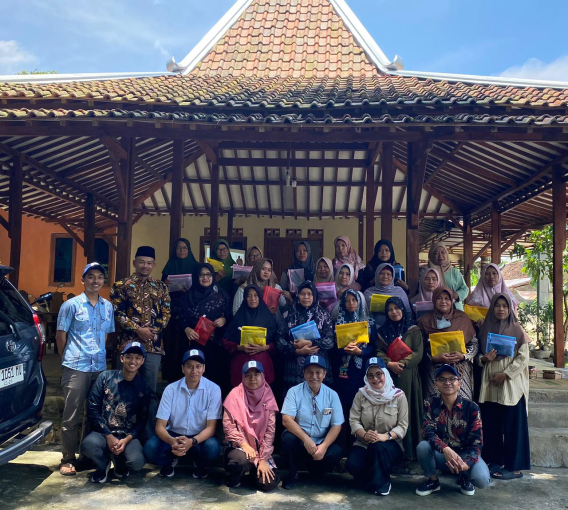
A team of lecturers from the Department of Agronomy, Faculty of Agriculture, Universitas Gadjah Mada (UGM), implemented a community service program entitled “Assistance in the Cultivation of Butterfly Pea (Clitoria ternatea) as an Antioxidant-Rich Functional Beverage to Improve Community Health Quality” on 2 October 2025. The program targeted the women farmers group (Kelompok Wanita Tani or KWT) Sri Rejeki in Ngrunggo, Getas, Playen, Gunungkidul Regency. The activity aimed to introduce the health potential of butterfly pea flowers while also promoting economic opportunities for the local community.
The program was initiated in response to the abundant presence of butterfly pea plants in the area, which have often remained underutilized by the community. In fact, butterfly pea flowers are known for their high antioxidant content and health benefits, including supporting immune function, reducing inflammation, and promoting skin health.
Butterfly pea is highly adaptable to dryland conditions such as those in Gunungkidul and requires relatively simple maintenance. According to Prof. Dr. Ir. Aziz Purwantoro, Head of the Community Service Team, this potential can be developed not only for household consumption to improve health, but also as a processed product with promising market value.
During the mentoring activities, participants, who were predominantly housewives, received comprehensive training covering butterfly pea cultivation techniques, post-harvest handling, and practical demonstrations of processing butterfly pea flowers into functional beverage products.
Ms. Paryanti, Coordinator of KWT Sri Rejeki, expressed her enthusiasm for the program. She stated that previously the community only recognized butterfly pea as an ornamental plant used along fences. Through this training, participants learned that butterfly pea can be processed into herbal tea and other beneficial products, which could become a new business opportunity to generate additional household income.
Through this community service initiative, the Department of Agronomy directly supports the achievement of the Sustainable Development Goals (SDGs), particularly SDG 3 on Good Health and Well-Being by promoting natural functional beverages to enhance community health, SDG 5 on Gender Equality through women’s empowerment, and SDG 8 on Decent Work and Economic Growth by creating opportunities for additional income.
Contributor: Yudha Pria Wibawa
Photo: Department of Agronomy