
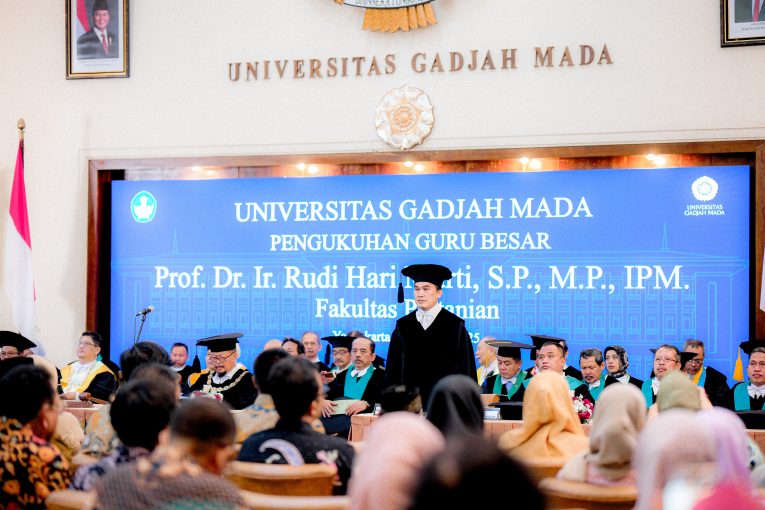
Yogyakarta, 21 January 2025 — Prof. Dr. Ir. Rudi Hari Murti, S.P., M.P., IPM, a lecturer in the Department of Agronomy at UGM, was inaugurated as a Guru Besar (Full Professor) in the field of Horticultural Plant Breeding at the Senate Hall, UGM Central Building. In the inauguration ceremony, Prof. Rudi delivered a speech titled “The Importance, Challenges, and Problem Solutions of Horticulture Through Efficient Plant Breeding Programs.”
In his speech, Prof. Rudi explained the importance of horticulture as a branch of agriculture that focuses on the cultivation of home-garden crops, such as fruits, vegetables, herbs, and ornamental plants. He stated that this sector plays a big role in providing healthy food, vitamins, and minerals, as well as supporting recreation. In addition, horticulture contributes to food security, environmental sustainability, the economy, and job creation.
The production of horticultural crops to achieve food security still faces various challenges, such as disease outbreaks, low productivity, poor product quality, rapid spoilage, long supply chains, rapidly changing consumer tastes, and shrinking land area. To overcome these challenges, Prof. Rudi suggested efforts to improve quality and productivity through the use of superior varieties that are stress-tolerant, both via conventional breeding and modern technologies such as genetic engineering. “The activities to produce superior varieties are carried out through assembling varieties using conventional breeding methods synergized with current methods such as genetic engineering, marker-assisted selection, and genome editing,” he explained.
Furthermore, horticultural products such as vegetables and fruits, which are seasonal and perishable, pose challenges in distribution, especially for exports and supermarkets that demand consistently high quality supply. Therefore, plant breeders must pay attention to product characteristics according to market segments to increase the competitiveness of horticultural products in both domestic and international markets.
Prof. Rudi also discussed the opportunity for more streamlined and efficient breeding strategies in hybrid production, which can help address these challenges by producing varieties that are more shelf-stable and have qualities aligned with market demand. Some of the breeding strategies mentioned include creating homozygous lines and using male sterility.
The creation of homozygous plants in a shorter time can be achieved through haploid induction methods, whether in vitro or in vivo, which will produce highly pure homozygous lines faster than conventional breeding methods. Meanwhile, using male sterility in hybrid seed production can increase the efficiency of emasculation processes while ensuring higher purity of seeds.
Prof. Rudi also emphasized the importance of synergy across scientific disciplines to accelerate the creation of homozygous plants (such as double haploids and male sterility), in order to generate hybrid crops that are highly productive, of the best quality, and stress-tolerant. “The combination of haploid inducer technology and male sterility in plant breeding can accelerate the breeding process and improve efficiency in hybrid seed production,” Prof. Rudi elaborated.
The inauguration of Prof. Rudi as Full Professor and his speech focusing on horticultural plant breeding support several Sustainable Development Goals (SDGs), including SDG 2: Zero Hunger, SDG 4: Quality Education, and SDG 12: Responsible Consumption and Production.
Author: Mareta Aulia Putri
Editor: Yudha Pria Wibawa
Photo: Faculty of Agriculture Media, UGM